How to Flush Microplastics From Your Body With Kimchi
There is a particular kind of quiet dread that comes with knowing something is inside you that you never invited in.
Microplastics. We have so become accustomed to hearing that naughty little word. However, we have sadly not become immune to the reality it represents.
These particles are in our water, our food, our blood, and according to growing research, in our brains and our placentas too. For many of us, especially those of us trying to raise healthy families and live as naturally as possible, this knowledge sits heavy.
What do we do with it? Where do we even begin?

So when a piece of genuinely exciting research crosses my desk, something with real scientific weight behind it, not hype, not a headline designed to scare you into buying something, of course, I have to bring it straight to your attention!
This one involves kimchi. And it might just be one of the most hopeful things I have read in the microplastics conversation in a long time.

What the Researchers Actually Found
In March 2026, the World Institute of Kimchi in South Korea, a government-funded research institute, published findings in the peer-reviewed journal Bioresource Technology that identified a specific probiotic strain found in kimchi with a remarkable ability to bind to nanoplastics and help carry them out of the body.
The strain in question is Leuconostoc mesenteroides CBA3656, one of the naturally occurring lactic acid bacteria that helps transform vegetables into kimchi and gives the finished product its characteristic tang.
The research team, led by Dr. Se Hee Lee and Dr. Tae Woong Whon, set out to understand whether this particular bacterium could bind to polystyrene nanoplastics, ultrafine plastic particles smaller than one micrometre, generated as larger plastics break down over time.
These particles are so small they can cross the intestinal barrier entirely and accumulate in organs including the kidneys and, more concerning still, the brain.
How Does It Actually Work?
Under standard laboratory conditions, CBA3656 demonstrated an impressive 87 percent adsorption efficiency with nanoplastics, meaning the bacteria physically bound to the plastic particles at a remarkably high rate. A comparison strain performed similarly under these initial lab conditions.
But here is where it gets genuinely interesting, and where CBA3656 set itself apart.
When the researchers recreated a simulated human intestinal environment, mimicking the digestive enzymes, pH changes, and conditions your gut actually experiences, the comparison strain’s effectiveness collapsed dramatically, dropping to just 3 percent.
CBA3656, however, maintained a substantially higher adsorption rate of 57 percent under these same challenging conditions.
This matters enormously, because a probiotic that only works in a sterile lab setting is scientifically interesting but practically useless. A probiotic that holds up under the actual chaos of human digestion is a different story entirely.
The researchers found that specific functional groups on the bacterium’s cell wall, certain chemical structures researchers identified through infrared spectroscopy, appear to be responsible for physically grabbing onto the nanoplastic particles and holding on.
The Animal Study: What Happened in the Mice
Lab results are one thing. What happens in a living body is another question entirely, and this is where the research moved from promising to genuinely compelling.
To get a clearer picture of what CBA3656 was doing, the researchers worked with germ-free mice. Because these mice lack their own gut microbiome, any changes could be more confidently attributed to the probiotic itself. One group received CBA3656 and another served as a control.
The result: mice given the kimchi-derived probiotic excreted more than double the amount of nanoplastics in their feces compared to the control group, and this effect was consistent across both male and female mice.
In plain terms, the bacteria appeared to bind to the nanoplastic particles within the gut and effectively help carry them out of the body through normal elimination, rather than allowing them to linger and potentially cross into the bloodstream or accumulate in tissue.
What This Research Does Not Yet Tell Us
In the spirit of the honest, research-backed approach you know I always bring, let’s be clear about the limitations here, because they matter.
The researchers used germ-free mice to create a highly controlled environment for testing the strain. That makes it a useful first step, but it is a long way from the complexity of the human gut microbiome.
The researchers themselves acknowledged this limitation. The researchers were careful not to overstate their findings. They noted that they still need further studies to understand how the strain would interact with the complex microbial ecosystems already present in the human gut. An exciting and potentially interesting finding though if you ask me!
Researchers have not yet tested this strain in human clinical trials. At this stage, researchers cannot tell us how much kimchi, how often, or over what period of time a person would need to consume it to achieve a meaningful result.
It is also important to keep the findings in perspective. Researchers have not isolated and concentrated this strain into a specific supplement. The study examined the bacterium as it naturally occurs in properly fermented kimchi.
In other words, the research is not telling us to take a particular probiotic product. It is exploring the potential effects of a naturally occurring bacterium already present in a traditional fermented food.
Dr. Lee was careful not to overstate the findings. In describing the research, she noted that microorganisms derived from traditional fermented foods have potential. Specifically in addressing the public health challenges posed by plastic pollution. Potential is the operative word, and good science respects that distinction.
What the study demonstrates is not a cure or a recommendation. It demonstrates a measurable biological mechanism that may help explain how a naturally occurring probiotic in fermented kimchi could support the body’s handling of micro and nano-plastics.
That is not nothing. That is the kind of finding that opens doors for years of further research to come.

Why This Matters So Much for Women
Microplastic exposure is not gender neutral in its implications. Research has linked nanoplastic exposure to growing concerns about reproductive health. Studies have found microplastic particles in human placentas and breast milk.
Against that backdrop, questions about how the body processes and removes these particles become highly practical. They matter to women planning a pregnancy, carrying a pregnancy, breastfeeding, or protecting their long-term health. It is deeply personal.
This research also reinforces a broader idea. Traditional fermented foods are more than cultural traditions or culinary preferences. They are super interesting, biologically complex foods… And modern science is still uncovering the full extent of what they may be doing within the body.
For centuries, Korean households have made kimchi using traditional fermentation methods. They were not trying to solve a modern environmental problem. Yet research suggests that some of the microorganisms created through that process play a now vital role in helping the body respond to one.

Where Does Kimchi Actually Come From? A Brief History
The significance of this research becomes clearer when viewed in its cultural context. Kimchi is not simply a fermented food. It has been woven into everyday Korean life for centuries.
Koreans have fermented vegetables for more than two millennia. The practice dates back to the Three Kingdoms period (roughly 37 BCE to 668 CE).
The earliest versions of kimchi looked very different from those we know today. They contained no chili peppers and no vibrant red colour.
Instead, people relied on salt and fermentation. These simple techniques preserved food through long winters when fresh vegetables were scarce. The chili pepper that gives modern kimchi its signature heat and colour did not arrive until centuries later.
Red chili peppers arrived in Korea in the early 17th century. Portuguese traders introduced them during the period of the Japanese invasions.
Even then, kimchi did not change overnight. It took many years for chili peppers to become a defining ingredient.
The first known kimchi recipe to include red pepper appeared in a Korean cookbook in 1765. For most of kimchi’s history, it looked very different from the vibrant red dish we know today.
One thing has remained constant for more than two millennia. Families and neighbours have gathered to make kimchi together. This tradition is known as kimjang. It involves preparing large batches of kimchi to last through the winter months.
Its cultural significance extends far beyond food. UNESCO has recognised kimjang as an Intangible Cultural Heritage of Humanity. In 2013, the Korean government also formally recognised kimchi as a national dish.
Across Korea, people make kimchi in hundreds of different ways. Napa cabbage may be the most familiar version, but it is far from the only one.
Kimchi can be made with radish, cucumber, and many other vegetables. Local climate and seasonal availability have shaped these variations over generations.This is not a single fixed recipe handed down unchanged. Kimchi is not a fixed recipe. It is a tradition that has evolved alongside the people making it.
That adaptability makes it remarkably accessible. As you will see below, the cabbage in your own kitchen is often enough to begin.
What the Population Data Shows: Real Health Outcomes in Kimchi-Eating Cultures
The nanoplastics research is only part of the story. Kimchi has also been the subject of extensive population-level research in Korea.
That is partly because researchers have a unique opportunity to study it. Most Koreans eat kimchi regularly throughout their lives.
On average, Koreans consume around 18 kilograms of kimchi each year. That makes kimchi one of the most consistently consumed fermented foods in the world.
People eat it regularly, often over the course of a lifetime. That has given researchers an unusually rich opportunity to study its long-term health effects.
A large cross-sectional study published in BMJ Open examined data from 115,726 Korean adults aged 40 to 69. The data came from the Health Examinees study.
Researchers found a meaningful association between regular kimchi consumption and lower obesity rates.
Men who ate three or more servings of cabbage kimchi daily showed a 10 percent lower prevalence of obesity. They also showed a 10 percent lower prevalence of abdominal obesity.
Researchers compared these men with those eating less than one serving daily.
Women who ate two to three servings daily showed an 8 percent lower prevalence of obesity. (Source)
Longer-term research has produced similar findings. One analysis used 13 years of data from the Korea Genome and Epidemiology Study.
Researchers observed a notable association between appropriate kimchi intake and lower obesity risk.
Among middle-aged men, kimchi consumption was linked to a 15 percent reduction in BMI. It was also associated with a 12 percent decrease in obesity incidence.
Beyond weight, one clinical trial looked at fermented kimchi powder. The study used a randomised, double-blind, placebo-controlled design. Researchers often consider this the gold standard.
Participants consumed fermented kimchi powder daily for 12 weeks. Compared with the placebo group, they showed a significant reduction in body fat mass.
They also showed an increase in beneficial gut bacteria. This included Akkermansia muciniphila, a species increasingly associated with metabolic health and a healthy gut lining.

It’s important to hold this data honestly. Most of the evidence comes from observational studies. These studies can identify patterns, but they cannot establish direct cause and effect.
The researchers are transparent about that limitation.
What makes the findings interesting is their consistency. Large population studies, randomised trials, and emerging microbiome research all suggest a similar story.
No single study settles the question. Taken together, however, the evidence becomes more compelling and exciting!
A Highly Rated Homemade Kimchi Recipe, Adaptable to Any Cabbage You Can Find
I know not everyone reading this will have easy access to napa cabbage, the traditional choice for Korean kimchi.
The beautiful thing about kimchi as a living tradition rather than a fixed recipe is that it was always designed to work with whatever vegetables a family had on hand.
So consider this your foundational, well-loved method, with notes on how to adapt it to what’s available to you.
Simple Homemade Kimchi
Equipment
- 1 large jar
Ingredients
For the cabbage
- 1 medium head napa cabbage about 1.3kg (or green, white, or savoy cabbage, cut into similar-sized wedges)
- 60 g coarse sea salt plus extra for layering
- 1.5 litres filtered or spring water
For the kimchi paste
- 1 tablespoon glutinous rice flour mixed with 60ml water or 60ml water alone if unavailable
- 1 tablespoon sugar coconut sugar or honey both work well
- 5 to 6 cloves garlic finely grated
- 1 tablespoon fresh ginger finely grated
- 2 to 4 tablespoons gochugaru Korean chili flakes, adjust to taste
- 2 tablespoons fish sauce or soy sauce, tamari, or miso paste for a vegetarian version
- 1 small onion roughly chopped
To finish
- 1 small Korean radish or daikon julienned, about 200g
- 4 spring onions cut into 4cm lengths
- 1 carrot julienned (optional, for colour and sweetness)
Instructions
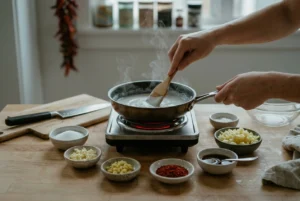
- Brine the cabbage. Cut the cabbage lengthwise into quarters and remove the core. Cut each quarter crosswise into bite-sized pieces, or leave as whole wedges if you prefer traditional leaf-style kimchi. Dissolve the salt in the water, submerge the cabbage, and weigh it down with a plate. Leave for 2 hours, turning halfway, until the white parts bend without snapping.1 medium head napa cabbage, 60 g coarse sea salt, 1.5 litres filtered or spring water
- Rinse and drain. Rinse the cabbage thoroughly under cold water two to three times to remove excess salt. Taste a piece, it should be pleasantly salty, not overwhelming. Drain well in a colander for 15 to 20 minutes.
- Make the paste. Heat the rice flour and water in a small pan over low heat, stirring until it thickens into a light paste, then let it cool. Blend the cooled paste with the sugar, garlic, ginger, gochugaru, fish sauce, and onion until smooth.1 tablespoon glutinous rice flour mixed with 60ml water, 1 tablespoon sugar, 5 to 6 cloves garlic, 1 tablespoon fresh ginger, 2 to 4 tablespoons gochugaru, 2 tablespoons fish sauce, 1 small onion
- Combine. In a large bowl, toss the drained cabbage with the radish, spring onions, and carrot. Pour over the paste and, using gloved hands, massage it into every piece until fully and evenly coated.1 small Korean radish or daikon, 4 spring onions, 1 carrot
- Pack and ferment. Pack tightly into a clean glass jar, pressing down so the brine rises above the vegetables. Leave 3cm of space at the top. Seal and leave at cool room temperature for 1 to 5 days, pressing down daily to keep everything submerged. Taste from day 1, it is ready whenever it suits you.
- Store. Once it reaches a tang you love, move the jar to the fridge. It will keep for several months, growing tangier with time.




Notes
The Bigger Picture
We are living through an extraordinary moment in the natural health world, one where modern science is increasingly circling back to validate what traditional food cultures have known instinctively for generations.
Kimchi was never created with nanoplastics in mind. It was created out of necessity, out of a need to preserve food through harsh winters, refined slowly over centuries by women in Korean households who were simply trying to feed their families well.
And yet here we are, with a government-funded research institute and a peer-reviewed international journal confirming that this humble, fermented cabbage dish may carry a genuinely powerful tool for addressing one of the most pressing health concerns of our modern times.
This is exactly why I believe so deeply in honouring traditional, ancestral approaches to food and healing, not blindly, or without questioning, but with genuine curiosity and respect.
Sometimes the answers we are searching for in laboratories have been quietly fermenting in clay pots for centuries, waiting for science to catch up.
FAQs
Q: Can kimchi really help remove microplastics from the body?
A: A 2026 peer-reviewed study published in Bioresource Technology found that a specific probiotic strain found in kimchi, Leuconostoc mesenteroides CBA3656, can bind to nanoplastic particles and promote their excretion. In an animal study using germ-free mice, this resulted in more than double the nanoplastic excretion compared to a control group. This research is promising but still in early stages, and human clinical trials have not yet been conducted.
Q: What are nanoplastics and why are they concerning?
A: Nanoplastics are ultrafine plastic particles smaller than one micrometre, formed as larger plastics break down in the environment. They can enter the human body through food and drinking water, and due to their extremely small size, may cross the intestinal barrier and accumulate in organs including the kidneys and brain.
Q: Can I make kimchi with regular cabbage instead of napa cabbage?
A: Yes. While napa cabbage is the traditional choice, kimchi has always been an adaptable, regional tradition made from whatever vegetables were available. Green, white, and savoy cabbage all ferment well using the same brining and seasoning method, though denser cabbages may need a slightly longer brining time.
Q: How healthy is kimchi, really?
A: Large population studies from Korea, where kimchi is eaten daily by most of the population, have linked regular consumption to lower rates of obesity and abdominal obesity. A randomised controlled trial also found that daily kimchi consumption significantly reduced body fat and increased beneficial gut bacteria compared to a placebo.
References:
Lee, J., Lee, M.J., Jung, M., et al. “Efficient biosorption of nanoplastics by food-derived lactic acid bacterium.” Bioresource Technology, 2026. DOI: 10.1016/j.biortech.2026.134234
Jung H, Yun Y-R, Hong SW, et al. Association between kimchi consumption and obesity based on BMI and abdominal obesity in Korean adults: a cross-sectional analysis of the Health Examinees study. BMJ Open. 2024;14:e076650.