Seeded Grapes: Nature’s Tiny Powerhouses for Healing and Energy
SimplyLila.com articles may contain affiliate links, and the information provided is for educational and informational purposes only. Please read the full disclosure HERE.
Why This Humble Fruit Might Be Nature’s Best Medicine
There’s a woman most people have never heard of who, in 1927, claimed she cured her own cancer by eating nothing but grapes.
Her name was Johanna Brandt, and whether you take her story at face value or hold it with a healthy dose of curiosity, what she understood about this small, deeply ordinary fruit was far ahead of her time.
Because modern science has since gone on to confirm what ancient healers, Hippocrates among them, already knew: seeded organic grapes are genuinely remarkable.
Not the pale, perfectly round, seedless variety sitting in plastic bags at every supermarket. The real ones. The dark, seeded, slightly imperfect clusters that most of us walk straight past.
This post is about those grapes, what they contain, what they’ve historically been used for, and how you can bring more of their healing potential into your everyday life.

Why Did Ancient Healers Use Grapes as Medicine?
Grapes have been part of the human diet for over 8,000 years. From ancient Egypt to classical Greece, they were eaten, pressed, and prescribed, not just as food or wine, but as genuine medicine.
Hippocrates, widely considered the father of medicine, reportedly used grapes to address inflammation and blood-related conditions.
What he was observing empirically, without any of our modern lab tools, was the effect of a fruit dense in polyphenols. These are natural compounds that interact with the body in ways science is still working to fully understand.
That thread of traditional knowledge carried forward for centuries, right up until a South African naturopath picked it up and turned it into one of the most talked-about natural healing books of the twentieth century.

What Is the Grape Cure and Is There Anything to It?
The Story of Johanna Brandt and Her Famous Book
In 1927, Johanna Brandt published a book simply called The Grape Cure, in which she described overcoming cancer through a strict therapeutic diet built almost entirely around seeded grapes.
Her protocol wasn’t casual snacking. It was an intentional, structured approach based on the belief that grapes could detoxify the blood, rebuild tissue at a cellular level, provide deep nourishment without feeding diseased cells, and give the body the conditions it needed to heal itself.
Mainstream medicine dismissed her at the time, as it tends to do with anything that sits outside its own framework.

But her book found an audience among those looking for natural alternatives, and it’s still in print today, read by people who are curious about what food can actually do when used with real intention.
I want to be honest here: I’m not making medical claims, and neither did Brandt without her own caveats. But I do think her instincts about the healing potential of this specific fruit were pointing at something real, and the science that has followed is worth taking seriously.
If you’re curious about fasting as a complementary healing practice, my post on why more people are turning to water fasting and how to start explores a lot of the same underlying principles around giving the body space to reset.

What Makes Seeded Organic Grapes So Different from Regular Grapes?
Seeded vs Seedless: Why the Seed Actually Matters
This is the part that tends to surprise people. Most of us have grown up eating seedless grapes without giving it a second thought.
They’re convenient, sweet, and frankly easier to eat. But the seed is where a significant portion of the grape’s therapeutic value actually lives.
Grape seeds are dense with proanthocyanidins, a class of antioxidant that strengthens blood vessel walls, supports collagen production, and protects cells against oxidative damage.

When you remove the seed, you remove one of the most potent parts of the fruit. Seedless varieties also tend to have lower overall polyphenol content because they’re typically bred for sweetness and shelf life, not nutritional density.
Dark varieties are best: Concord, Red Globe, Black Corinth, and similar cultivars have higher concentrations of the compounds that do the most work. Colour is a reliable guide, the deeper the skin, the more anthocyanins and resveratrol it tends to contain.
And organic matters here more than with most produce. Conventional grapes consistently appear on the Environmental Working Group’s Dirty Dozen list as one of the most heavily pesticide-sprayed crops available. More on what to do about that in a moment.
How Did Seedless Grapes Become the Default, and What Did We Lose?
The short answer is: convenience won.
From the mid-twentieth century onward, commercial agriculture increasingly selected for traits that made fruit easier to grow, pack, ship, and sell. Seedless varieties stayed fresh longer in transit, were easier for consumers to eat quickly, and tended toward the kind of uniform sweetness that supermarkets and buyers preferred. It made complete commercial sense.
It’s worth being clear that this was conventional selective breeding. The same process humans have used to shape crops for thousands of years. It isn’t genetic modification in the modern laboratory sense.
But selective breeding still has consequences. When you consistently breed for sweetness, shelf life, and the absence of seeds? Phytochemical complexity tends to be bred out at the same time.
Seeds exist in fruit for a reason. They’re the plant’s reproductive investment, and nature protects that investment with concentrated defensive compounds.
And those include the very polyphenols that make seeded grapes therapeutically interesting. When the seed goes, a significant portion of that protective chemistry goes with it.

We also lost something subtler: the seasonal relationship with fruit. Grapes were traditionally a harvest food, eaten fresh and whole during a relatively short window each year. That seasonal rhythm meant the body received a concentrated burst of specific compounds at a particular time, rather than a diluted version available twelve months a year. Context matters when we’re trying to understand what food actually does.
None of this is an argument against seedless grapes entirely. It’s just useful to understand what drove the shift, and what we might be missing by treating the seedless version as the standard.
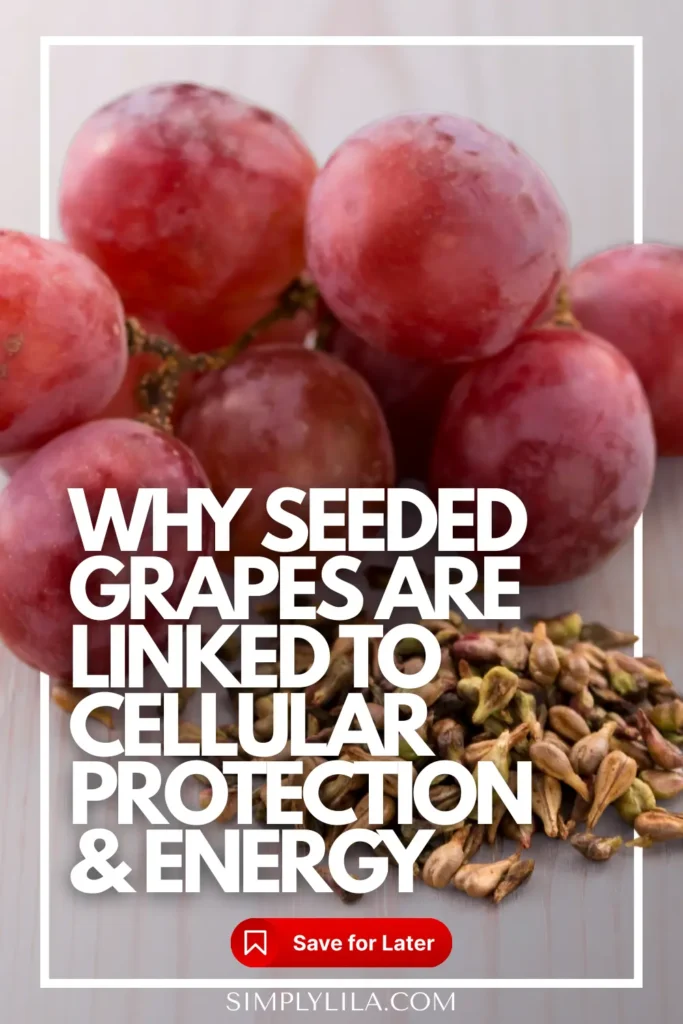
What Are the Real Health Benefits of Seeded Grapes?
Antioxidants That Actually Reach Your Cells
The skin and seeds of dark seeded grapes contain two antioxidant compounds that have been studied extensively: resveratrol and proanthocyanidins.
Resveratrol has attracted serious scientific attention for its potential anti-aging, anti-inflammatory, and cardioprotective effects.
Studies published in peer-reviewed journals have explored its role in reducing oxidative stress at a cellular level, which is the kind of damage linked to accelerated aging and chronic disease.
Proanthocyanidins, concentrated almost entirely in the seed, work in concert with resveratrol to protect blood vessels and support the body’s own repair processes.
There’s something else worth understanding about these compounds that often gets missed. Polyphenols are not a source of energy in the caloric sense, they don’t provide fuel the way carbohydrates do.
What they do is support the cellular machinery that produces energy. Resveratrol in particular has been studied for its interaction with mitochondria, the structures inside cells responsible for converting nutrients into usable energy.
Supporting mitochondrial function is a quieter, slower kind of nourishment than a sugar hit, but it’s the kind that actually lasts. This is why seeded grapes can feel genuinely sustaining rather than just temporarily sweet.
And then there’s the bitterness. If you’ve chewed a grape seed and recoiled slightly at the astringency, that reaction is worth paying attention to rather than avoiding.
Bitterness and astringency are biological signals. They’re the taste of protective plant compounds, and our modern preference for sweetness has trained many of us to interpret that signal as something unpleasant rather than something useful.
The seed isn’t bitter despite being good for you. It’s bitter because it is. Eating the whole grape, skin, flesh, and chewed seed, gives you access to all of it.
A Natural Blood and Lymph Cleanser
Grapes are alkaline-forming, which means they support the body’s natural effort to maintain a balanced internal pH.
They’re also gently diuretic, supporting kidney function and encouraging the elimination of metabolic waste.
This is what Brandt was pointing at with her detoxification claims. She may not have had the language of modern nutritional science, but the underlying mechanism she described, grapes helping the body flush what it no longer needs, holds up reasonably well when you look at what the compounds actually do.
Steady, Clean Energy Without the Crash
The natural sugars in grapes, fructose and glucose, are absorbed differently from refined sugar. When eaten as whole fruit with the fibre of the skin intact, they provide a gentler, more sustained energy release than processed foods or even fruit juice.
They’re a genuinely useful snack before exercise, during a cleanse, or any time you need energy without the spike and crash of something processed.

Heart Health That’s Backed by Research
Multiple studies have found associations between regular grape consumption and measurable improvements in cardiovascular markers, including reduced blood pressure, improved cholesterol ratios, and decreased arterial inflammation.
The research links these effects primarily to the polyphenol content, particularly resveratrol, which appears to support the flexibility and health of arterial walls.

Iron Support for Low Energy and Anemia
Dark grapes contain meaningful amounts of iron alongside vitamin C, which is significant because vitamin C dramatically improves the body’s ability to absorb plant-based iron.
For anyone dealing with low iron levels, fatigue, or anemia, adding dark seeded grapes to the diet is a practical and gentle support, particularly as part of a broader iron-rich eating approach.
If you’re exploring natural ways to support your energy levels more broadly, my post on the benefits of eating dates daily covers another whole food that works brilliantly alongside grapes for sustained natural energy.
Whole Seeds or Grape Seed Extract: Is There a Difference?
This is a question worth answering directly because a lot of people who read about the benefits of grape seeds often wonder. Would a supplement capsule might be easier than chewing through a bunch of dark grapes.
Grape seed extract is a concentrated, isolated form of proanthocyanidins derived from grape seeds. It’s widely available, well-studied, and for specific therapeutic purposes, such as supporting vascular health or managing oxidative stress at higher doses, extracts can be genuinely useful.
But there are a few things a capsule doesn’t replicate.
When you eat a whole seeded grape, you’re consuming the seed compounds alongside resveratrol from the skin. Let’s not forget the natural sugars and fibre from the flesh, vitamin C, iron, and a full spectrum of other phytochemicals.
These compounds don’t work in isolation in the whole fruit. They interact with each other, and that synergy affects how they’re absorbed and used by the body. Nutritional science has a term for this: the food matrix effect. Isolated extracts bypass it.
Whole food also engages the digestive system differently. Chewing the seed stimulates saliva production and digestive signalling in a way that swallowing a capsule simply doesn’t. That mechanical and biochemical process is part of how the body prepares to absorb and use what it’s receiving.
My honest take: if you’re eating seeded grapes regularly and looking for an additional targeted boost for something specific, a quality grape seed extract can complement that.
But it shouldn’t replace the whole fruit, and it certainly isn’t a shortcut to the same benefit. The capsule gives you one piece of the picture. The grape gives you the whole thing.

How Do You Actually Use Grapes for Healing?
The Everyday Approach
You don’t need to do a full grape fast to benefit from what this fruit offers. The simplest starting point is just eating them more intentionally, and more often.
Choose organic dark seeded varieties wherever you can. Wash them properly (more on that below). Eat them slowly, chewing the seeds as thoroughly as possible rather than spitting them out.
The bitterness you taste in the seed is the polyphenols, and that’s exactly what you want.
Some of my favourite everyday ways to enjoy them:
- Add a handful to your morning smoothie, seeds and all! Add banana, alongside blueberries, a slice of cucumber, a teaspoon of chia seeds, and your preferred plant milk for a genuinely beautiful antioxidant-rich drink.
- Toss them into salads for a sweet contrast against bitter greens, toasted seeds, and a simple lemon dressing.
- Freeze a bowl of them for a refreshing, naturally sweet summer snack. Totally feels more like a treat than a health food.
- Blend a cup with fresh lemon juice and a little cold water for a simple, cleansing drink that’s as good as it sounds.
Please Note: Whole seeds are a choking risk for children under five, but the nutritional benefit of including them via a blended smoothie is absolutely worth it.
A handful of dark seeded grapes blended with banana and plant milk is one of the simplest, most nourishing things you can put in front of your small person. I personally use my Vitamix blender for the smoothest of smooth smoothies!

The Grape Cure Approach
For those curious about a more focused protocol in the spirit of Johanna Brandt’s approach, the basic framework is straightforward.
Eat organic seeded grapes as your primary food for one to three days, drink plenty of pure spring water, rest as much as possible, and allow the body to do what it does when given the right conditions and a break from the demands of heavy digestion.
If you’re considering extending this beyond a day or two, or if you have any existing health conditions, please work with a knowledgeable natural health practitioner who can guide you through the process and help you know what to expect.
This isn’t about following instructions blindly, it’s about doing it with understanding.

What About Pesticides? How to Wash Grapes Properly
If organic grapes aren’t available or affordable where you are, please don’t skip them entirely. Just wash them properly.
Fill a bowl with clean drinking water and add one teaspoon of bicarbonate of soda per litre of water. Submerge the grapes and let them soak for five to ten minutes, then rinse thoroughly under clean running water.
This simple method removes a significant portion of surface pesticide residue. and is far better than a quick rinse under the tap. It’s the method I use at home and I genuinely wouldn’t skip it.
Organic or homegrown is always the preference, especially for grapes, given how heavily conventional crops are sprayed. But if it’s between non-organic grapes washed properly and no grapes at all, wash them and eat them.
If you prefer to use a ready-made organic produce wash, you could try Fit Organic Soaker Produce Wash. This is said to remove sprayed waxes as well as pesticide residues.

Practical Takeaways: How to Get More from Seeded Grapes
Before you move on, here’s a quick summary of what to actually do:
- Choose dark, seeded, organic varieties wherever possible. Concord, Red Globe, and Black Corinth are excellent options.
- Eat the whole grape including the seed, chewing it as thoroughly as you can.
- Add them to smoothies, salads, or eat them frozen as a snack.
- Try a one to three day grape focus if you’re curious about a gentle seasonal cleanse.
- Wash all non-organic grapes in a bicarbonate of soda solution before eating.
- Pair with other iron-rich and vitamin C-rich foods if you’re supporting low energy or anemia.
- If you’re preparing grapes for young children, blend or finely chop to remove the seed texture entirely.

Nature Doesn’t Always Shout
We live in an era of powders and capsules and supplement stacks. Every month there’s a new superfood being flown in from somewhere remote, packaged beautifully, and sold at a premium.
And then there are seeded organic grapes. Sitting quietly at the market. Dark and a little imperfect. Easy to overlook.
Hippocrates worked with them. Johanna Brandt staked her life on them. Modern science keeps finding reasons to take them seriously.
Sometimes the things that have been quietly nourishing people for thousands of years are exactly the things worth paying attention to.
So next time you pass them by, slow down. Pick up a bunch. Eat them properly. See how you feel.

Further Reading
For those who want to go deeper, Johanna Brandt’s The Grape Cure is widely available online and in print. For science-backed context, the PubMed review on grapes and cardiovascular health and the Journal of Food Biochemistry study on inflammatory markers are both worth your time.

Frequently Asked Questions About Seeded Grapes and Their Benefits
Q: Are seeded grapes actually healthier than seedless grapes? A: Yes, and meaningfully so. The seeds contain concentrated proanthocyanidins and other polyphenols that are largely absent from seedless varieties. Seedless grapes are also typically bred for sweetness and shelf life. NOT nutritional density, which affects their overall polyphenol content. If you have a choice, choose seeded.
Q: What did Johanna Brandt’s Grape Cure actually involve? A: Brandt’s protocol centred on eating only organic seeded grapes, typically dark varieties, for an extended period. These would range from a few days to several weeks, alongside plenty of pure water and rest. She believed the grapes detoxified the blood, starved diseased cells, and provided deep cellular nutrition. Her book, published in 1927, remains in print and is considered a foundational text in natural healing circles.
Q: What are the best varieties of seeded grapes to buy? A: Dark varieties with high polyphenol content are the most beneficial. Concord grapes are among the most studied and nutritionally rich. Red Globe, Black Corinth, and Muscat varieties are also excellent choices. The darker the skin, the higher the anthocyanin and resveratrol content tends to be.
Q: How do you eat grape seeds properly? A: Chew them as thoroughly as you can. They’re bitter, which is the taste of the polyphenols, and that bitterness is a sign you’re getting the good stuff. You can also blend whole grapes, seeds and all, into smoothies if chewing isn’t for you. Avoid swallowing whole seeds without chewing as you won’t absorb much benefit that way.
Q: Is it safe to do a grape fast or grape cure at home? A: A one to three day grape focus is generally well tolerated by healthy adults, particularly as a gentle seasonal cleanse. For anything longer, or if you have existing health conditions, blood sugar concerns, or are pregnant, please work with a qualified natural health practitioner before starting. This is about doing it with understanding, not following a protocol blindly.
Q: How do you remove pesticides from non-organic grapes? A: Soak them in a bowl of clean water with one teaspoon of bicarbonate of soda per litre for five to ten minutes, then rinse thoroughly under clean running water. This removes a significant amount of surface pesticide residue. It’s not a perfect solution, and organic is always preferable, but it’s substantially better than a quick rinse alone.
Q: Can grapes help with anemia or low iron? A: Dark seeded grapes contain iron alongside vitamin C, which the body uses to absorb plant-based iron more efficiently. They’re a useful supportive food for anyone dealing with low iron or fatigue, particularly when paired with other iron-rich whole foods. They’re not a standalone treatment, but as part of a considered diet they can make a genuine difference.